The presence of crows and pigeons in urban areas is becoming increasingly significant and difficult to manage, especially to maintain the hygiene of the environment and avoid unpleasant incidents due to the territorial behaviour of the birds. However, companies have tried to contain this problem: How?
Several techniques are used.The most common method of restricting the accumulation of pigeons on buildings is the installation of mechanical pin bollards: iron pins that are theoretically supposed to scare away the flying birds. In practice, however, they do not have the desired effect. Firstly, the pigeons gather on these 'metal spikes' and build their nests between them, creating an even more stable tangle of twigs and foliage. Secondly, the sharp materials can injure them, leading to unnecessary suffering and an even greater spread of disease.
The second method is the use of pigeon defence nets, which are not only aesthetically unattractive but also more dangerous than the metal spikes described above. In fact, many birds, especially smaller ones, try to get through the holes in the net and become trapped. Birds of prey also often get their claws and legs caught in the wires. Both situations lead to an inhumane consequence: a slow and painful death.
The latest technique used by the companies is the introduction of the radio-controlled eagle: a copy of a larger bird that flaps its wings loudly to scare away crows and pigeons. Although this method appears to be effective at first, it proves to be completely useless after a short time: crows and pigeons are intelligent enough to recognise that the bird is not real and quickly learn to ignore it.
Our company, Swiss Falconry, has developed an environmentally friendly and sustainable method to solve the problem and ensure balance in the ecosystem, cleanliness and peace in areas populated by crows and pigeons. How does bird control work?All other attempts to get rid of pesky birds have failed over the years; the only certainty is that they are extremely expensive methods.
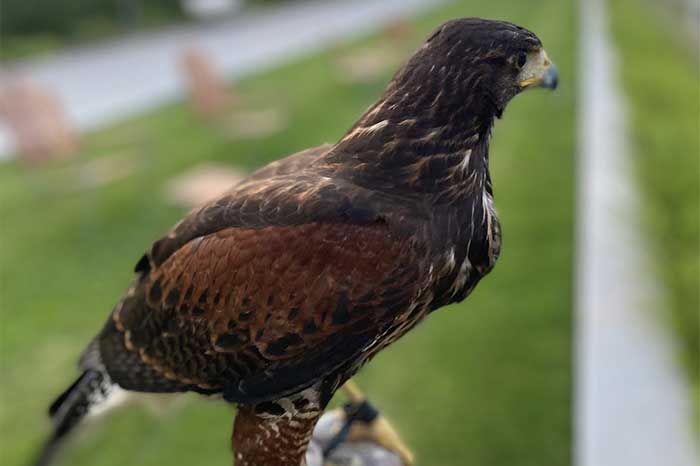
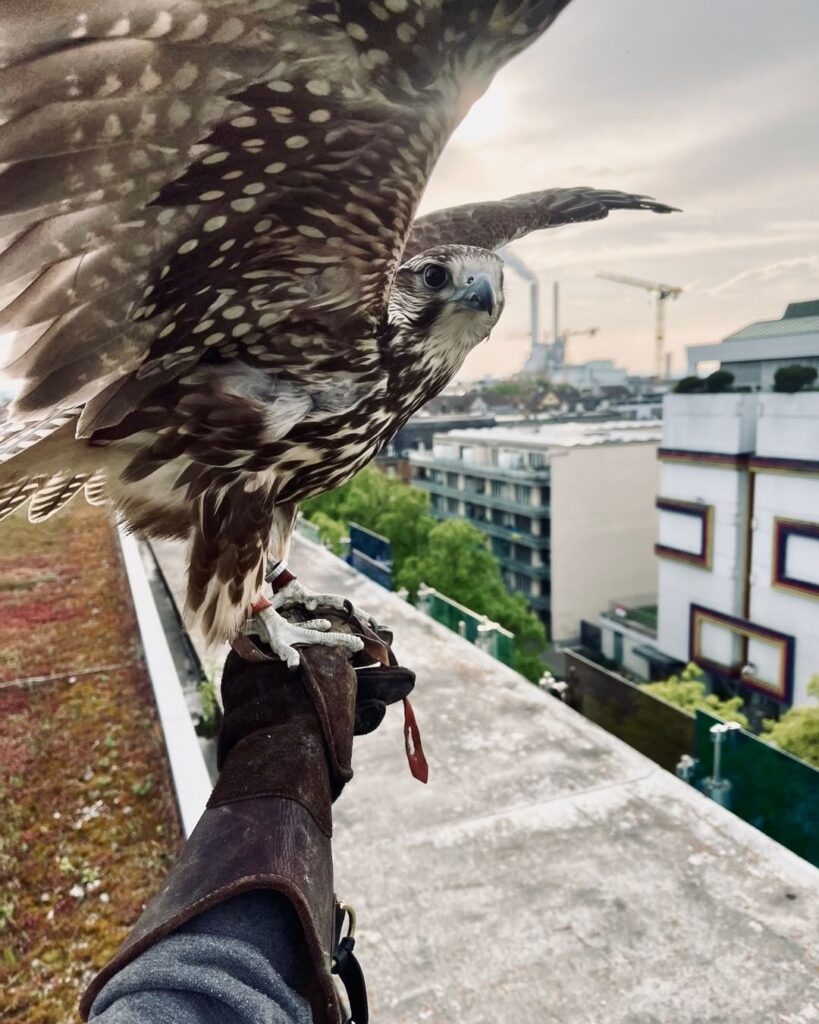
We have learnt a combination of ancient falconry techniques and innovative training to enable our team of birds of prey to hunt and intimidate nuisance birds in both urban and agricultural environments.
Thanks to our intervention, which comprises two phases, a first intensive phase six days a week for two hours and a second maintenance phase, which is more sporadic but regular, the presence of crows and pigeons will soon be a distant memory.
There are falcons and owls of different sizes that are trained for different purposes: The former, depending on the species and size, are used in small, medium and large areas to scare away birds or to hunt weaker prey due to their animal instinct; the latter, very large birds of prey with a truly extraordinary wingspan, have the particularity of being nocturnal animals, which are therefore the ideal solution for disturbing the resting time of crows and pigeons during twilight.
Our seriousness and commitment allow us to work in any environment, be it urban, agricultural or industrial: we have trained our animals to the best of our ability and they can adapt to any situation. It is precisely because of the passion we put into our work that we demand the utmost respect.
Our birds of prey are our colleagues, whom we take impeccable care of every day by feeding them high-quality food and supplying their immune systems with vitamins. They live in an ideal environment with the highest standards of hygiene and comfort.
We invite you to learn more about our modus operandi in future articles.If you have any questions, please contact us via our contact form on our website or directly by e-mail or telephone.